Her sonnet presentation was today
It’s a pleasant beginning to term 2
She used to think sonnets were just okay
But now, she knows, they’re really fun to do
The form is characterized by a turn
Or volta, a change of perspective, tone
But, as Professor says, with some concern
Good sonnets fall within a certain zone
What’s good about sonnets, says Stephen Fry
Is that they’re just right – the Goldilocks form
Size enough for a thought, flexible, spry
Sonnets can both entertain and inform
The difficulty in sonnets is not
in the writing, but in how they are wrought

Friday, May 13, 2011

Wednesday, May 11, 2011
Of Cures, Fixes, and Multi-Billion Dollar Ideas
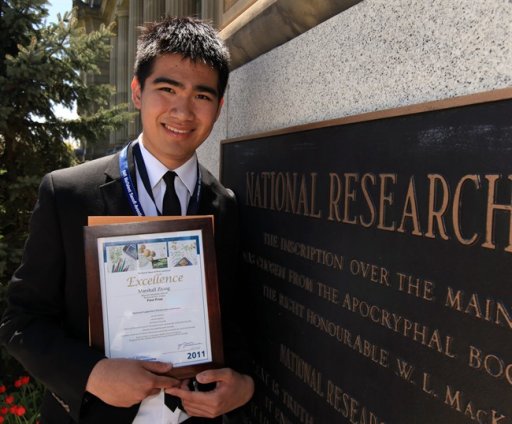 In Ottawa, they recently held the National Research Council's 2011 Biotalent Challenge Awards. In essence, it's an ordinary high school science competition, but the competitors in this particular competition were anything but ordinary.
Here's what the top 5 competitors did:
1st Place - Found a cure for cystic fibrosis. Did this on his off time after finishing homework, by logging in to the SCINET supercomputer to run simulations. Even tested the cure on real cell cultures. What do you know! It worked.
2nd Place - Developed a food additive that will be worth billions of dollars. They found a way to take gelatin out of sorbet, replacing it with a compound that is a) cheaper, and b) opens the up the market for sorbet to vegetarians around the world who avoid gelatin as it is derived from animals.
3rd Place - Discovered a bacteria that inhibits the growth of antibiotic resistant bacteria. Basically, it boils down to a way of helping the prevent the death of millions when our antibiotics start failing to deal with super-bacteria that laughs at our paltry medicine.
4th Place - Discovered how pregnancy hormones can help prevent multiple sclerosis. It seems these hormones protect neurons from iron accumulation.
5th Place - Discovered a better way to treat cancers like leukemia. So... basically this high school student found a better cancer cure. I guess they needed something to do while waiting for the next Twilight movie to come out.
All of this, from high schoolers in Canada. High schoolers. You know, the twitter-headed computer addicts who are supposedly the leading edge in the dumbing down of the human race.
Workshopping Long Form Fiction
I think long form fiction can be workshopped successfully, but it depends on the nature of the workshop and the structure of the class. In an opt-res program, where people have jobs, this may not work so well. But in a normal residency program, why not? I used to have to read a novel a week for some of my lit classes, and when I sit down to read, 300 pages is the work of an afternoon at a coffee shop, really.
In a full workshop setting, it may be a bit much to go novel by novel, week after week. But if you broke a 20 person workshop into five groups of four, you could workshop five pieces simultaneously, and what's more, you could do task oriented editing sessions. Say one month is spent on overall structure, or plot. The next month on characterization. The next on dialogue. The next... etc...
By the time the year is over, each long form work has had five or six close reads, with all the editing and polishing that comes along with that.
You can keep the groups the same, or change them up. There are pluses and minuses to both. By keeping groups together, they become intimately familiar with each others work, and can better comment on each. By switching up the groups, you keep things fresh, and prevent small-group-think from setting in.
All that is required is that students have a long form work already prepared before the workshop begins, which can be ascertained at the time of registration. Call it a pre-requisite, if you will.
In a full workshop setting, it may be a bit much to go novel by novel, week after week. But if you broke a 20 person workshop into five groups of four, you could workshop five pieces simultaneously, and what's more, you could do task oriented editing sessions. Say one month is spent on overall structure, or plot. The next month on characterization. The next on dialogue. The next... etc...
By the time the year is over, each long form work has had five or six close reads, with all the editing and polishing that comes along with that.
You can keep the groups the same, or change them up. There are pluses and minuses to both. By keeping groups together, they become intimately familiar with each others work, and can better comment on each. By switching up the groups, you keep things fresh, and prevent small-group-think from setting in.
All that is required is that students have a long form work already prepared before the workshop begins, which can be ascertained at the time of registration. Call it a pre-requisite, if you will.
Tuesday, May 10, 2011
A Damascene Conversion
Lee Goldberg is a prolific blogger, TV Writer, and author. In Sara Graefe's TV Writing class, his work and thoughts on TV writing are (or were...are they still?) part of the syllabus.
Tiring of the TV writing game, Goldberg fell into novelizations, continuing his work on shows like Monk and Diagnosis Murder by writing novels that carried on the stories after the shows had ended.
He does modestly well. No blockbusters, but enough to pay the bills. And he has also been a known, vociferous critic of the concept of self-publishing.
Until now.
Before June 5, 2009, he'd earned a grand total of $0 on his out-of-print work, Then he published them on the Kindle. As he states:
So far, so sensible, but then he drinks the Kool-Aid with a smile.
And then there's a caveat for new authors.
Read the whole post here.
Tiring of the TV writing game, Goldberg fell into novelizations, continuing his work on shows like Monk and Diagnosis Murder by writing novels that carried on the stories after the shows had ended.
He does modestly well. No blockbusters, but enough to pay the bills. And he has also been a known, vociferous critic of the concept of self-publishing.
Until now.
Before June 5, 2009, he'd earned a grand total of $0 on his out-of-print work, Then he published them on the Kindle. As he states:
...out-of-print books that I wrote years ago [] were earning me nothing before June 2009.
If those sales hold for the rest of the year, I will earn $77,615 in Kindle royalties, and that’s not counting the far less substantial royalties coming in from Amazon UK, Smashwords, Barnes & Noble and CreateSpace.
Even if my sales plummet tomorrow by fifty percent, I’ll still earn about $38,000 in royalties this year…and I’d be very, very happy with that.
My most profitable title, in terms of hours worked and pages written, is THREE WAYS TO DIE, a collection of three previously published short stories. In print, it’s a mere fifty-six pages long, but it’s selling 24 copies-a-day on the Kindle, earning me about $1500-a-month. That means I could potentially earn $18,000 this year just from those three short stories alone.
That is insane.
So far, so sensible, but then he drinks the Kool-Aid with a smile.
But what would be more insane is if I took my next, standalone, non-MONK book to a publisher instead of “publishing” it myself on the Kindle.
That’s right. I’d rather self-publish. This from a guy who for years has been an out-spoken, and much-reviled, critic of self-publishing. But that was before the Kindle came along and changed everything. I was absolutely right then…but I’d be wrong now.
The Kindle offers mid-list writers a real option to consider before they sign their next, shitty contract extension with their publisher…and it has given new opportunity to every mid-list author who has been dropped…and it has dramatically re-energized the earnings potential of every published author’s out-of-print back-list.
That’s incredibly exciting. I believe that any midlist author who isn’t self-publishing, either their back list or new work, is making a costly mistake.
And then there's a caveat for new authors.
If you’ve never been in print before, I believe you’d be a fool not to take a mid-list paperback or a hardcover deal…even a terrible one…over self-publishing on the Kindle. Financially, you might make less (either in failure or modest success)...but the difference will be more than made up for in editing, marketing, wider readership, wider name recognition, and professional prestige (and that prestige does mean something, whether you want to admit it or not).
You can always go back to self-publishing... and when you do, you will be bring that wider readership, name recognition, and professional prestige with you. But a book deal doesn't come along every day, and that's still going to mean something for a long time yet...and I suspect it still will even if half the bookstores in America close tomorrow.
Read the whole post here.
Monday, May 9, 2011
Game Over, Paper Books!
You know, there's an irony floating about out there, or maybe "cognitive dissonance" might be the better term, if you will, but what it is is that it seems to me that of the people I meet, chat, or message with, the ones who are the hottest and botheredest about the environment, who grit their teeth every time a Ford Explorer drives by, and who have (or totally-would-have-if-they-could-have) chained themselves to a majestic redwood to face down armies of ravenous bulldozers intent on raping mother nature, are the very same people who feel that it is far far better to fill their homes with paper books, which are essentially lumps of dead tree - that had to be cut, transported, processed, bleached, shipped, packaged, shipped, printed on, bound, shipped, stocked, bought, and then transported into a home library - than to download an e-book and read it on something non-organic.
Odd, that.
But no fear, the end of dead tree media is here!
A few months ago, the NY Times finally, belatedly bowed to plain common sense, and is factoring in sales of e-books into their lists.
I think the picture below illustrates the effect pretty clearly.

Now I've heard a few objections to my hypothesis over the past few months, which I'll list out below.
#1 - Promoting e-books only serves to promote e-readers which are often made from "conflict minerals" and from other materials that are both non-biodegradable and toxic to the environment. E-books, then hurt Mother Earth.
It's tru that e-readers aren't made of air, hope, rainbows, or flowers. But the thing is that you only need one.
Every single book that is bought has to go through that long production and distribution chain. If one the making of one book has less of an impact on the environment than the making of one e-reader, the making of ten, fifty, one hundred books does not.
As for electricity, if you were in a mind to be green, the amount of electricity it takes to transfer and read an e-book would take about 10 minutes of turning a hand crank to generate. But if you wanted to make your own hardcover... well that process is s little more involved! :-)
#2 - People prefer the physicality of books. There is no substitute to the feel of the page.
Well, when Armageddon, or the singularity arrive, they will either help us rebuild civilization, or defeat the army of robots attempting to rule the earth.
But seriously...
I used to think I would never stop loving the feel of paper beneath my fingertips, or the heft of a good novel as I lay on my side on the couch, elbow propped up, my thumb nimbly flicking pages in rapid succession.
But like any marriage or partnership that has grown too close, with too little space, for too long, I started noticing the little things - the tiny paper cuts, the unending weekly dusting, the fatigue in the arm and wrist, the social stigma of reading in the workplace (oh, and just forget about bringing one along to the relatives, friends), and to top it all off, when the book was done, it became dead weight in my hand, it's part over, offering no further solace, consolation, intimacy, or joy. It...it just lays there! Ugh! Like it doesn't even know I'm there any more!
So I knew it was time for a divorce, to send 1.0 packing, and ring up 2.0 - bringing in the shiny and the new.
I tell you, my sweet little iPod Touch 4G and I, we shall be together forever.
#3 - Using e-books in schools is difficult because the expense factor prevents widespread adoption of e-readers. Ordinary folk just can't afford to lose an e-reader.
I live in a part of the world where the poorest Canadian would seem almost middle class by comparison, yet somehow even the poorest of the poor here have access to mobiles.
This is an older article (2008) but it illuminates the trajectory in the developing world, and the impact that mobiles are having on everything from commerce, to education, to entertainment.
As the OLPC initiative has shown, where there is a will, there is a way. That said, from a school perspective, schools that issue out e-readers to their students, or laptops in 1-to-1 Districts (New Brunswick has a big program along these lines) can send students their allotment of textbooks wirelessly as they are added or connected to courses they are registered in.
No more textbook shortage, no more "I forgot my book" excuses, no more ratty outdated texts, no more torn or vandalized pages. All of these can be romanticized, but as a teacher who has been on both sides of this issue, I am so very glad I don't have to deal with the headaches that hardcopy school texts bring along with them.
Plus, the advantages for teachers are enormous. Instead of literally cutting, pasting, photocopying, and distributing supplementary materials in class (all of which takes enormous amounts of time), in a soft-copy system, all you need to do is insert excerpts from the textbook into a Word document, add in your exercises, save and send as an attachment (or upload, or put in a public folder, etc).
I've reduced my prep time by 80% by abandoning paper, and I have been able to ensure (literally, and measurably) more engagement with texts, including objective assessments of comprehension. One thing a textbook cannot do is record video of a student reading a text or doing an oral exercise. But in a 1-to-1 environment, you can record and store every stage of a student's progress, over years if need be, that can be instantly accessed when consulting with students, parents, or school admin.
All of this is to the benefit of students, especially those of fewer means.
#4 - Fewer paper books means fewer future yard sales where you can stumble across an old, forgotten treasure. You can't sell e-books at a yard sale.
Well I sure didn't find the entire archive of Chekov's short stories in a garage sale.
I am a lover of garage sales, and nothing draws me like a sale of used books. I used to line up at every library sale in the area. Every year I made a trip to Kemptville to see my grandad and go to "Hey! Day" where there would be a massive three day sale of used books (and everything else) in support of the local hospital.
But more often than not, I notice that, table after table of used books I pass by (and still do, if only out of sheer stubborn habit) there is little I would want to read there.
I remember when my neighbour invited me to go through her basement, through the many boxes of books, and take whatever I wanted. She wanted to clean out her old books. But out of the endless boxes and stacks, I think I found six books I wanted to read. The rest were throwaway romances or Danielle Steele type hardcovers. This kindly old lady was not an atypical member of the general public.
Honestly, I'd prefer not to wade through a sea of Dan Browns or James Pattersons anymore.
To sum it up, I'd say there are certainly books that I will keep, and not give away... My hardcover special edition of Lord of the Rings, my Norton Anthologies, the rare school texts I dug up in the bins of used books stores that date from the turn of the century, etc. These are books that I value for reasons beyond just wanting to read them - they are objets d'art, windows into the past.
Personally, I love digging up old science fiction, pulp paper backs from the forties and fifties that you can still find floating around, with the cheap yellowed paper and the smell of countless sweaty hands all over them. But once I've read them, the moment has gone, the little one night stand is done, and few people I know would really want to pick up my old copy of Olaf Stapeldon or E.E. Doc Smith. On a whim, I decided to read some old Heinlein in e-Book form and I found myself drawn in and absorbed in the same way I had with the old yellowing paperbacks. It turned out that it wasn't the book - the object - that was the needed thing, it was the story itself.
Perhaps I flog the e-book thing because when it comes to paper books, I'm like a recovering heroin junkie, and when I walk into a bookstore all I can see is sweet fine China in every direction, just filling my ear with promises of ecstasy, and all I need do is swipe the credit card one more time to keep on chasing that dragon.
That siren song seduced me every time, until I realized, at a later date, that my addiction to books, my compulsion to hit an Indigo, or Chapters, or Bakka, or any of the innumerable used bookstores I would frequent a couple times a week, and leave with yet another pile of paperbacks or trade paperbacks had put me in a deep financial hole.
I think that writers, especially, reserve a special place for books, a place they do not, and perhaps can not question. It's hard to see books as things, as objects. To us they are invested with a tiny spark of the divine, and thus beyond question or reproach.
But like Po learned at the end of Kung Fu Panda, it's not the dragon scroll that matters, it's the lesson the scroll represents.
Odd, that.
But no fear, the end of dead tree media is here!
A few months ago, the NY Times finally, belatedly bowed to plain common sense, and is factoring in sales of e-books into their lists.
I think the picture below illustrates the effect pretty clearly.
Now I've heard a few objections to my hypothesis over the past few months, which I'll list out below.
#1 - Promoting e-books only serves to promote e-readers which are often made from "conflict minerals" and from other materials that are both non-biodegradable and toxic to the environment. E-books, then hurt Mother Earth.
It's tru that e-readers aren't made of air, hope, rainbows, or flowers. But the thing is that you only need one.
Every single book that is bought has to go through that long production and distribution chain. If one the making of one book has less of an impact on the environment than the making of one e-reader, the making of ten, fifty, one hundred books does not.
As for electricity, if you were in a mind to be green, the amount of electricity it takes to transfer and read an e-book would take about 10 minutes of turning a hand crank to generate. But if you wanted to make your own hardcover... well that process is s little more involved! :-)
#2 - People prefer the physicality of books. There is no substitute to the feel of the page.
Well, when Armageddon, or the singularity arrive, they will either help us rebuild civilization, or defeat the army of robots attempting to rule the earth.
But seriously...
I used to think I would never stop loving the feel of paper beneath my fingertips, or the heft of a good novel as I lay on my side on the couch, elbow propped up, my thumb nimbly flicking pages in rapid succession.
But like any marriage or partnership that has grown too close, with too little space, for too long, I started noticing the little things - the tiny paper cuts, the unending weekly dusting, the fatigue in the arm and wrist, the social stigma of reading in the workplace (oh, and just forget about bringing one along to the relatives, friends), and to top it all off, when the book was done, it became dead weight in my hand, it's part over, offering no further solace, consolation, intimacy, or joy. It...it just lays there! Ugh! Like it doesn't even know I'm there any more!
So I knew it was time for a divorce, to send 1.0 packing, and ring up 2.0 - bringing in the shiny and the new.
I tell you, my sweet little iPod Touch 4G and I, we shall be together forever.
#3 - Using e-books in schools is difficult because the expense factor prevents widespread adoption of e-readers. Ordinary folk just can't afford to lose an e-reader.
I live in a part of the world where the poorest Canadian would seem almost middle class by comparison, yet somehow even the poorest of the poor here have access to mobiles.
This is an older article (2008) but it illuminates the trajectory in the developing world, and the impact that mobiles are having on everything from commerce, to education, to entertainment.
As the OLPC initiative has shown, where there is a will, there is a way. That said, from a school perspective, schools that issue out e-readers to their students, or laptops in 1-to-1 Districts (New Brunswick has a big program along these lines) can send students their allotment of textbooks wirelessly as they are added or connected to courses they are registered in.
No more textbook shortage, no more "I forgot my book" excuses, no more ratty outdated texts, no more torn or vandalized pages. All of these can be romanticized, but as a teacher who has been on both sides of this issue, I am so very glad I don't have to deal with the headaches that hardcopy school texts bring along with them.
Plus, the advantages for teachers are enormous. Instead of literally cutting, pasting, photocopying, and distributing supplementary materials in class (all of which takes enormous amounts of time), in a soft-copy system, all you need to do is insert excerpts from the textbook into a Word document, add in your exercises, save and send as an attachment (or upload, or put in a public folder, etc).
I've reduced my prep time by 80% by abandoning paper, and I have been able to ensure (literally, and measurably) more engagement with texts, including objective assessments of comprehension. One thing a textbook cannot do is record video of a student reading a text or doing an oral exercise. But in a 1-to-1 environment, you can record and store every stage of a student's progress, over years if need be, that can be instantly accessed when consulting with students, parents, or school admin.
All of this is to the benefit of students, especially those of fewer means.
#4 - Fewer paper books means fewer future yard sales where you can stumble across an old, forgotten treasure. You can't sell e-books at a yard sale.
Well I sure didn't find the entire archive of Chekov's short stories in a garage sale.
I am a lover of garage sales, and nothing draws me like a sale of used books. I used to line up at every library sale in the area. Every year I made a trip to Kemptville to see my grandad and go to "Hey! Day" where there would be a massive three day sale of used books (and everything else) in support of the local hospital.
But more often than not, I notice that, table after table of used books I pass by (and still do, if only out of sheer stubborn habit) there is little I would want to read there.
I remember when my neighbour invited me to go through her basement, through the many boxes of books, and take whatever I wanted. She wanted to clean out her old books. But out of the endless boxes and stacks, I think I found six books I wanted to read. The rest were throwaway romances or Danielle Steele type hardcovers. This kindly old lady was not an atypical member of the general public.
Honestly, I'd prefer not to wade through a sea of Dan Browns or James Pattersons anymore.
To sum it up, I'd say there are certainly books that I will keep, and not give away... My hardcover special edition of Lord of the Rings, my Norton Anthologies, the rare school texts I dug up in the bins of used books stores that date from the turn of the century, etc. These are books that I value for reasons beyond just wanting to read them - they are objets d'art, windows into the past.
Personally, I love digging up old science fiction, pulp paper backs from the forties and fifties that you can still find floating around, with the cheap yellowed paper and the smell of countless sweaty hands all over them. But once I've read them, the moment has gone, the little one night stand is done, and few people I know would really want to pick up my old copy of Olaf Stapeldon or E.E. Doc Smith. On a whim, I decided to read some old Heinlein in e-Book form and I found myself drawn in and absorbed in the same way I had with the old yellowing paperbacks. It turned out that it wasn't the book - the object - that was the needed thing, it was the story itself.
Perhaps I flog the e-book thing because when it comes to paper books, I'm like a recovering heroin junkie, and when I walk into a bookstore all I can see is sweet fine China in every direction, just filling my ear with promises of ecstasy, and all I need do is swipe the credit card one more time to keep on chasing that dragon.
That siren song seduced me every time, until I realized, at a later date, that my addiction to books, my compulsion to hit an Indigo, or Chapters, or Bakka, or any of the innumerable used bookstores I would frequent a couple times a week, and leave with yet another pile of paperbacks or trade paperbacks had put me in a deep financial hole.
I think that writers, especially, reserve a special place for books, a place they do not, and perhaps can not question. It's hard to see books as things, as objects. To us they are invested with a tiny spark of the divine, and thus beyond question or reproach.
But like Po learned at the end of Kung Fu Panda, it's not the dragon scroll that matters, it's the lesson the scroll represents.
Sunday, May 8, 2011
Magic and the Fantastic
First published by the New Yorker in 1998, and subsequently included in the collection Pastoralia, “Sea Oak” is a tale of the bottom rung of contemporary American life, but with a twist.
There is a story that when Ben Stiller read “Sea Oak”, he laughed his ass off, and wanted to secure the rights to the story for a film treatment. Indeed, the humour, subtle and otherwise, in this story is one the most praised elements of the tale. A number of reviewers, having taken to “Sea Oak”, saw within it a biting satire of contemporary American life, especially in the way that Saunders takes on and mocks corporate brands. At times it felt that Sea Oak was placed alongside Dawn of the Dead in it’s attack on consumerist society.
Or so they say. Personally, I didn’t really read it the same way. For me, “Sea Oak” represents a different message, a different ethos which can only be properly summed up by the decrepit, dissolving Bernie – to succeed in life, you have to show your cock.
Now, before we get too carried away here, and before you get to wondering why I seem to be reviewing one short story rather than getting on with the presentation, I want you to know that there is a point, and though the road may be long and winding, there is a destination.
So, where were we?... Ah yes, that’s right. Show your cock.
In “Sea Oak”, Saunders creates a world that is just different enough from our own that we readers can effectively step outside the fictive universe and look down on the events as spectators who recognize the symbols, but are otherwise removed from the world of the story. A key reason for creating this distinct environment is that it better facilitates what the author needs for the story to function – the smooth and willing suspension of disbelief. As readers, when reading stories set in our own, known reality, we tend to notice and unfairly focus on the smallest details that intrude upon our sense of veritas, and in the real world, characters as breathtakingly stupid as Jade and Min would come across as caricatures (or as a misogynist projection), which would make the reader’s ability to understand and assimilate the author’s message much more difficult.
But in a world that is not our world, a world that is just slightly off enough to seem somewhat like our own, but clearly distinct and different, then the author has far more leeway to establish norms of behaviour and the rules of the environment, and, conversely, the reader has more leeway to accept those norms and rules.*
A very powerful and literarily awarded example of this is Kazuo Ishiguro’s “Never Let You Go,” where the unreality of the world is enough to keep the reader from being frightened off by the concept, yet enough like our world that the pathos and tragedy can flow through the soul.
All this is well and good, but the question still begs – why? Why would a writer dip into magic and the fantastic? Generally, or at least the reason I have found, is that they do so because they got something to say. That is, they have a message.
All stories contain themes or overarching messages. The difference is the focus. Where in literature a story might address broader themes such as “growing up gay in southwestern Wisconsin”, or “nostalgia, loss, and sisterhood,” stories that delve into magic and the fantastic tend to have far more focused themes. In the case of “Sea Oak” the message is not “corporate/consumerist America sucks, dude” but “dude, corporate/consumerist America sucks, so what are you going to do about it?”
In “Sea Oak”, Saunders elicits the fantastic by slightly caricaturizing every aspect of the story. The characters are extreme (a bit too stupid, a bit too passive, a bit too timid), and the actions and events likewise. At the beginning of the story, in the club “Joysticks”, a worker, with a family and limited prospects, is summarily fired with a callousness that is rare in the western world. In the real world there would be labour laws, or even a sense of decency to draw upon. By opening up with this symbolic summary execution, Saunders is able to illustrate that we’re not in Kansas City anymore, Chief.
Saunders peppers the text with brand names that are clearly made up, but generic enough that what they represent is recognizable. This adds depth to the slight feeling of otherness the text evokes as the story progresses. At first glance, the message that seems to be developing is that this world (which is a lot like our world) traps the people in it (as, I suppose, our world is supposed to also do). Jade and Min are uneducated and stuck at home, too ignorant to care for their kids, too unskilled to have any hope of bettering their lives. Bernice is a caregiver and a doormat, she takes things as they come, and has let life just piss all over her, and did it with a smile. Then there is the narrator, who’s very timidity traps him in perpetual mediocrity. But then something changes.
So far we have the fantastic, the otherness that sets the scene. In “Sea Oak” the fantastic manifests in the oddness of the world. But the other factor, which is what will drive the story forward and the point home, is magic. In stories of magic and the fantastic, magic is the deus ex machina, the big dumb object, the macguffin. In every fairy tale or folk tale with a magical element, magic is what brings about the resolution, it is what allows for the change needed for the story to resolve, or for the point to be made. In “Sea Oak,” Bernie coming home for one last weekend is the magic that drives the story to its conclusion. Bernie’s rage and shame at letting life walk all over her has propelled her from the grave and briefly into the arms of her family, her poor, useless, stupid, deluded family, with a singular purpose in mind – to tell them to get off their asses and get a move on.
The message that Bernie so colorfully and emphatically communicates is that the world is as it is, and nothing is going to change that. But how you take on the world can, and must, change. This very Ayn Randish exhortation is accompanied by decisive action. She shows them how their inaction will directly result in the death of Troy, and in their slow living death in the Sea Oak tenements.
When Bernie sends her thumbprints onto patrons ho would be willing to pay for “extra services” from the narrator at his job at Joysticks, the intent is to show the narrator that the world is full of all kinds, and that there is no upside to being timid when you are stuck on the bottom.
Though the narrator does not follow Bernie’s instructions, by the time Bernie crumbles into mush pushed into a hefty bag and dumped into the back of a K-car, the narrator has his epiphany and finally understands.
Had this story been set in our real, known world, it would have come off like an after school special, or a Sunday sermon - something you would nod your head to, but otherwise not listen to. However, by anchoring this story in magic and the fantastic, Saunders is able to pull us up close and whisper something in our ear -
The moral, the message in this tale of magic and the fantastic is that in life, even if you don’t have much, you have to use what you have. Or, as Bernie would say, you have to show your cock.
* It is a very common, and very effective technique that is most often employed by literary writers who want to go slumming in the genre district, yet be able to hold their heads up high and claim they have done no such thing.
There is a story that when Ben Stiller read “Sea Oak”, he laughed his ass off, and wanted to secure the rights to the story for a film treatment. Indeed, the humour, subtle and otherwise, in this story is one the most praised elements of the tale. A number of reviewers, having taken to “Sea Oak”, saw within it a biting satire of contemporary American life, especially in the way that Saunders takes on and mocks corporate brands. At times it felt that Sea Oak was placed alongside Dawn of the Dead in it’s attack on consumerist society.
Or so they say. Personally, I didn’t really read it the same way. For me, “Sea Oak” represents a different message, a different ethos which can only be properly summed up by the decrepit, dissolving Bernie – to succeed in life, you have to show your cock.
Now, before we get too carried away here, and before you get to wondering why I seem to be reviewing one short story rather than getting on with the presentation, I want you to know that there is a point, and though the road may be long and winding, there is a destination.
So, where were we?... Ah yes, that’s right. Show your cock.
In “Sea Oak”, Saunders creates a world that is just different enough from our own that we readers can effectively step outside the fictive universe and look down on the events as spectators who recognize the symbols, but are otherwise removed from the world of the story. A key reason for creating this distinct environment is that it better facilitates what the author needs for the story to function – the smooth and willing suspension of disbelief. As readers, when reading stories set in our own, known reality, we tend to notice and unfairly focus on the smallest details that intrude upon our sense of veritas, and in the real world, characters as breathtakingly stupid as Jade and Min would come across as caricatures (or as a misogynist projection), which would make the reader’s ability to understand and assimilate the author’s message much more difficult.
But in a world that is not our world, a world that is just slightly off enough to seem somewhat like our own, but clearly distinct and different, then the author has far more leeway to establish norms of behaviour and the rules of the environment, and, conversely, the reader has more leeway to accept those norms and rules.*
A very powerful and literarily awarded example of this is Kazuo Ishiguro’s “Never Let You Go,” where the unreality of the world is enough to keep the reader from being frightened off by the concept, yet enough like our world that the pathos and tragedy can flow through the soul.
All this is well and good, but the question still begs – why? Why would a writer dip into magic and the fantastic? Generally, or at least the reason I have found, is that they do so because they got something to say. That is, they have a message.
All stories contain themes or overarching messages. The difference is the focus. Where in literature a story might address broader themes such as “growing up gay in southwestern Wisconsin”, or “nostalgia, loss, and sisterhood,” stories that delve into magic and the fantastic tend to have far more focused themes. In the case of “Sea Oak” the message is not “corporate/consumerist America sucks, dude” but “dude, corporate/consumerist America sucks, so what are you going to do about it?”
In “Sea Oak”, Saunders elicits the fantastic by slightly caricaturizing every aspect of the story. The characters are extreme (a bit too stupid, a bit too passive, a bit too timid), and the actions and events likewise. At the beginning of the story, in the club “Joysticks”, a worker, with a family and limited prospects, is summarily fired with a callousness that is rare in the western world. In the real world there would be labour laws, or even a sense of decency to draw upon. By opening up with this symbolic summary execution, Saunders is able to illustrate that we’re not in Kansas City anymore, Chief.
Saunders peppers the text with brand names that are clearly made up, but generic enough that what they represent is recognizable. This adds depth to the slight feeling of otherness the text evokes as the story progresses. At first glance, the message that seems to be developing is that this world (which is a lot like our world) traps the people in it (as, I suppose, our world is supposed to also do). Jade and Min are uneducated and stuck at home, too ignorant to care for their kids, too unskilled to have any hope of bettering their lives. Bernice is a caregiver and a doormat, she takes things as they come, and has let life just piss all over her, and did it with a smile. Then there is the narrator, who’s very timidity traps him in perpetual mediocrity. But then something changes.
So far we have the fantastic, the otherness that sets the scene. In “Sea Oak” the fantastic manifests in the oddness of the world. But the other factor, which is what will drive the story forward and the point home, is magic. In stories of magic and the fantastic, magic is the deus ex machina, the big dumb object, the macguffin. In every fairy tale or folk tale with a magical element, magic is what brings about the resolution, it is what allows for the change needed for the story to resolve, or for the point to be made. In “Sea Oak,” Bernie coming home for one last weekend is the magic that drives the story to its conclusion. Bernie’s rage and shame at letting life walk all over her has propelled her from the grave and briefly into the arms of her family, her poor, useless, stupid, deluded family, with a singular purpose in mind – to tell them to get off their asses and get a move on.
The message that Bernie so colorfully and emphatically communicates is that the world is as it is, and nothing is going to change that. But how you take on the world can, and must, change. This very Ayn Randish exhortation is accompanied by decisive action. She shows them how their inaction will directly result in the death of Troy, and in their slow living death in the Sea Oak tenements.
When Bernie sends her thumbprints onto patrons ho would be willing to pay for “extra services” from the narrator at his job at Joysticks, the intent is to show the narrator that the world is full of all kinds, and that there is no upside to being timid when you are stuck on the bottom.
Though the narrator does not follow Bernie’s instructions, by the time Bernie crumbles into mush pushed into a hefty bag and dumped into the back of a K-car, the narrator has his epiphany and finally understands.
Had this story been set in our real, known world, it would have come off like an after school special, or a Sunday sermon - something you would nod your head to, but otherwise not listen to. However, by anchoring this story in magic and the fantastic, Saunders is able to pull us up close and whisper something in our ear -
The moral, the message in this tale of magic and the fantastic is that in life, even if you don’t have much, you have to use what you have. Or, as Bernie would say, you have to show your cock.
* It is a very common, and very effective technique that is most often employed by literary writers who want to go slumming in the genre district, yet be able to hold their heads up high and claim they have done no such thing.
Sunday, April 10, 2011
Students Today?
An old Harvard entrance exam is circulating around the interwebs lately, and curious as I always am to peek into the schoolroom of the past, I thought I'd take a look. After reading through it, I found I had learned something, or at least come to alter my way of thinking about a topic that is well trod and well accepted - the idea that each generation is slightly less intelligent than the one preceding it.
Even though the exam is much harder than any test I have ever had to take, I found that it was not a sign that our current generations had a diminished academic/intellectual capacity, but that past generations had an extremely limited and focused education. You'll note that in the exam there are pretty much only two topics - classics (language and literature) and mathematics. The section "History and Geography" was a bit of a misnomer, because most of the history mentioned was classical Greek or Roman history, with three questions about rivers thrown in for good measure. There was nothing of physics, biology, chemistry, English literature, American history (or even any history around the world beyond pre-Byzantium). Let us also not forget the absence of social science, non-classical languages, comparative religion, music, economics, psychology, civics, political science, or art.
The thing I note from this exam is that a) students of today would fail this exam in the most spectacular fashion, and that b) the knowledge base of a modern student is so very broad that the students of yesteryear, who might have done well on an exam like this, would have seemed of limited education, parochial even, in comparison.
Even though the exam is much harder than any test I have ever had to take, I found that it was not a sign that our current generations had a diminished academic/intellectual capacity, but that past generations had an extremely limited and focused education. You'll note that in the exam there are pretty much only two topics - classics (language and literature) and mathematics. The section "History and Geography" was a bit of a misnomer, because most of the history mentioned was classical Greek or Roman history, with three questions about rivers thrown in for good measure. There was nothing of physics, biology, chemistry, English literature, American history (or even any history around the world beyond pre-Byzantium). Let us also not forget the absence of social science, non-classical languages, comparative religion, music, economics, psychology, civics, political science, or art.
The thing I note from this exam is that a) students of today would fail this exam in the most spectacular fashion, and that b) the knowledge base of a modern student is so very broad that the students of yesteryear, who might have done well on an exam like this, would have seemed of limited education, parochial even, in comparison.
Friday, February 18, 2011
Forget Smartboards
I came across a post by Jacob Gutnicki on Lisa Nielsen's The Innovative Educator, where she argues that interactive whiteboards, or Smartboards as they are more popularly known, are both a tool many educators love, and perhaps one of the most significant blocks to effective teaching in the modern classroom.
I couldn't agree more.
Technology is supposed to bring about the promise of the 1-to-1 classroom, where the focus is on the learning, and the teacher steps back from being the source and font of all knowledge to being but a lowly facilitator, a mere guide as students progress down the path of independent learning.
Currently, I work in a school equipped with Smartboards, and other than being a blank white screen for the projector, I find no use for them, whatsoever.
In my school, the students are all equipped with MacBook Pros, and a FAR better way to utilize technology in the classroom, I have found, is to prepare recordings of lessons before hand (allowing you to nicely edit and touch them up), then deliver those lessons, and the accompanying materials and follow-up tasks wirelessly when the class begins.*
In this way, the focus is never on the teacher at the front of the room, the students are engaged directly in the lesson, have immediate access to resources that assist them with questions and concerns (which facilitates independent learning), students of differing abilities can take the material at their own pace, the students get to literally, virtually "take" the teacher home with them for extra help and revision later on down the line, and the teacher is free to roam the room and facilitate learning.
It is the true student centered model of teaching.
*Mac is superb for this... I have not found a better way to transfer data in the classroom than through the Public Folder/Drop Box system on Macs.
I couldn't agree more.
Technology is supposed to bring about the promise of the 1-to-1 classroom, where the focus is on the learning, and the teacher steps back from being the source and font of all knowledge to being but a lowly facilitator, a mere guide as students progress down the path of independent learning.
Currently, I work in a school equipped with Smartboards, and other than being a blank white screen for the projector, I find no use for them, whatsoever.
In my school, the students are all equipped with MacBook Pros, and a FAR better way to utilize technology in the classroom, I have found, is to prepare recordings of lessons before hand (allowing you to nicely edit and touch them up), then deliver those lessons, and the accompanying materials and follow-up tasks wirelessly when the class begins.*
In this way, the focus is never on the teacher at the front of the room, the students are engaged directly in the lesson, have immediate access to resources that assist them with questions and concerns (which facilitates independent learning), students of differing abilities can take the material at their own pace, the students get to literally, virtually "take" the teacher home with them for extra help and revision later on down the line, and the teacher is free to roam the room and facilitate learning.
It is the true student centered model of teaching.
*Mac is superb for this... I have not found a better way to transfer data in the classroom than through the Public Folder/Drop Box system on Macs.
Tuesday, August 10, 2010
A Few More Russell Peters
Jamie Weinman, Macleans TV Critic, and a writer I often read and agree with, has me shaking my head in disagreement this morning, in a post where he roots for the demise of NBC's Outsourced, which is set to premiere this fall.
I really enjoyed the movie, and when I heard it was being turned into a TV show, I thought it was about time that we got a few South Asians on a show in North America. There have been sprinkles so far, with Anil Kapoor on the last season of 24, Kal Penn on House before he was hit by the politics bug, Reshma Shetty on Royal Pains, Aziz Ansari on P&R, and Archie Panjabi on The Good Wife, but the roles like that are few and far between for South Asian actors in North America, and especially in Canada.
At least in the UK there have been shows like Goodness Gracious Me, and The Kumars at No. 42. Toronto itself has a huge Bollywood scene (next year one of the major Indian movie awards shows will take place in Toronto), and yet when it comes to TV, as my South Asian actor friends tell me, it is a desert out there.
Personally I would like to see something like Outsourced turn that ship around and start to click. Amy Pohler is just fine and dandy, but I think I'd prefer to see more Russell Peters out there.
I really enjoyed the movie, and when I heard it was being turned into a TV show, I thought it was about time that we got a few South Asians on a show in North America. There have been sprinkles so far, with Anil Kapoor on the last season of 24, Kal Penn on House before he was hit by the politics bug, Reshma Shetty on Royal Pains, Aziz Ansari on P&R, and Archie Panjabi on The Good Wife, but the roles like that are few and far between for South Asian actors in North America, and especially in Canada.
At least in the UK there have been shows like Goodness Gracious Me, and The Kumars at No. 42. Toronto itself has a huge Bollywood scene (next year one of the major Indian movie awards shows will take place in Toronto), and yet when it comes to TV, as my South Asian actor friends tell me, it is a desert out there.
Personally I would like to see something like Outsourced turn that ship around and start to click. Amy Pohler is just fine and dandy, but I think I'd prefer to see more Russell Peters out there.
Exercising Prudence is a Lost Art
I came across this excerpt from the Toronto Star, via Macleans.
Stress and panic attacks? Too bad this wasn't prevented earlier by an attack of common sense.
Jump into a demonstration, on a whim, I can see. But during the G20, with the downtown full of police officers, and trouble makers, and after the press spent weeks obsessing over the possibility of violence, and the how the police were set to engage protesters, and you'd think that perhaps this woman might have, just for the tiniest moment, decided that prudence may be the better part of valor in this situation.
And yes, being arrested may be traumatic, but she was quickly cleared and let go, as any innocent person rounded up in a group engagement would be. You'd think she'd count herself lucky, having learned a lesson.
But no, that's not how things go, I guess.
Hopefully the courts won't reward her stupidity.
Toronto office administrator Sherry Good is now the face of a G20 class-action lawsuit filed Thursday against the Toronto Police Services Board and the federal attorney general, who represents the RCMP... Good said she was walking home from work on the evening of June 27 when she decided to join an informal demonstration. She was caught by a police technique known as “kettling” when about 250 people were encircled by a wall of police officers at the intersection of Queen St. W. and Spadina Ave. Good was released without charge, but said she suffered from stress and panic attacks as a result of the incident.
Stress and panic attacks? Too bad this wasn't prevented earlier by an attack of common sense.
Jump into a demonstration, on a whim, I can see. But during the G20, with the downtown full of police officers, and trouble makers, and after the press spent weeks obsessing over the possibility of violence, and the how the police were set to engage protesters, and you'd think that perhaps this woman might have, just for the tiniest moment, decided that prudence may be the better part of valor in this situation.
And yes, being arrested may be traumatic, but she was quickly cleared and let go, as any innocent person rounded up in a group engagement would be. You'd think she'd count herself lucky, having learned a lesson.
But no, that's not how things go, I guess.
Hopefully the courts won't reward her stupidity.
Subscribe to:
Posts (Atom)